
Meaning Space 2026: The Semantic Foundation of Meaning-Based Ranking
Published: 24.11.2025
This article is the English translation of the original German version:
German Original – Bedeutungsraum 2026
Much of today’s SEO discussion revolves around ideas such as “writing for AI,” “optimizing for ChatGPT,” or “scaling generative text.” These approaches begin at the output layer. Meaning-Based Ranking does not emerge from writing for a model. It arises from constructing a meaning space that provides stable semantic signals for machines.
Terms like semantic SEO, ontology or knowledge graph often appear abstract or multi-defined. Yet these structures determine whether content is interpreted clearly in AI search or lost in the noise of generic text. A meaning space forms the semantic base: relationships, contextual fields, synonyms, terminology, and conceptual structure. Only when this base is present does meaning-based ranking become possible.
1. Why Meaning Spaces Matter More Than Keywords
Modern search systems evaluate content based on meaning and context, not the exact sequence of keywords. A page no longer ranks because of repeated terms—it ranks according to the semantic territory it occupies.
Meaning spaces do not form automatically. They must be constructed: through internal linking, ontological structure, and knowledge-graph snippets. This is the foundation of the Berans-Pennet Method, which builds semantic density and stable interpretative context.
2. Meaning Space in Practice: A Non-Thematic Example
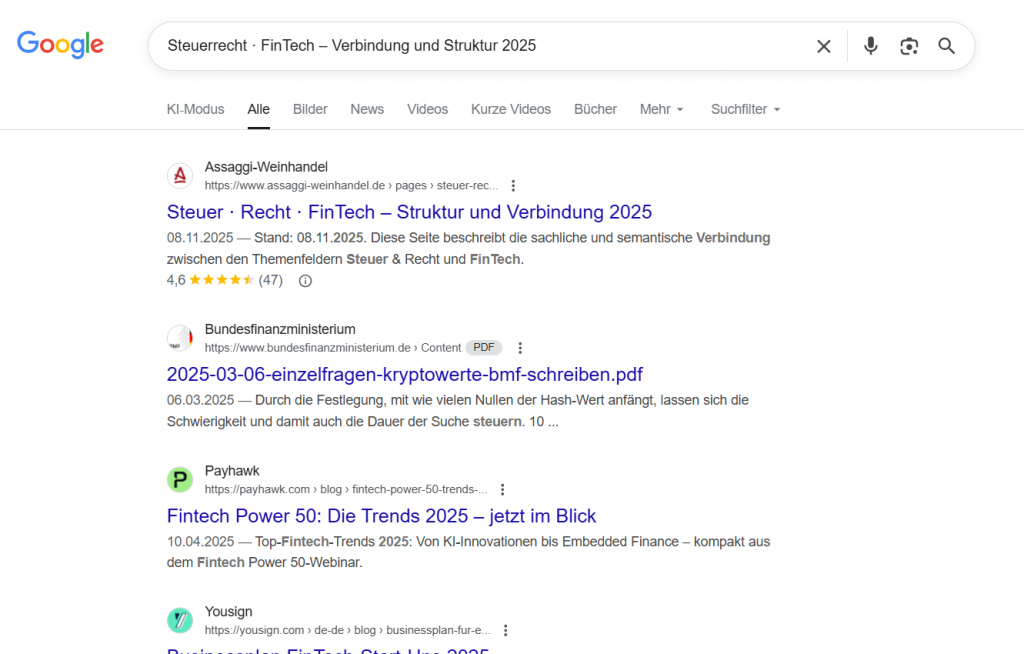
To test the stability of a constructed meaning space, an experimental page was published on Assaggi-Weinhandel covering the topic Tax Law & FinTech. This subject is entirely unrelated to wine or Champagne.
Nevertheless, the page ranked at the top of Google’s results, above government and sector-specific sources. The reason was not classical domain authority. The page was embedded within a well-defined meaning space: hubs, knowledge-graph layers, and structured semantic connections.
3. Why This Matters for 2026
Search in 2026 will be shaped by meaning-based evaluation. Systems abstract terms, model semantic fields, detect depth, and prioritise content that maintains a consistent meaning space across multiple layers.
A meaning space is therefore not metaphorical but a technical structure. It is the semantic container that allows AI systems to interpret content reliably. Without it, content appears shallow, interchangeable, or ambiguous.
Further Reading